
Updated Shadow Marking Instructions
Covenant Calendar Shadow Marking Instructions in March for the teshuva shadow!
We are excited as we prepare to mark the shadow for this March the teshuva/equinox. It's getting close and it's time to be getting your set up ready! It's an exciting season as we prepare for the season of our teshuva - our restoration and return. Be prepared for marking by about March 10th. Equinox days show up between Mar 19th – 21st; while we are still in the 365+ day civil year. For those who may be marking for their first time, or would like a refresher, here's a few key points! To get started with shadow marking, you will need:
1. A marking board (about the size of a poster – see point #7 below)
2. A fine tip marking pen (the finer, the better) - at least 4 different colors will be helpful as you'll see in the power point files.
3. A gnomon that will cast a shadow (a nail, tall stick pin - anything that you can secure so it will not move). Experiment with different sizes on the same board while you are at it [eg: 3½” & 6”].
4. Sewing thread - to pull a line (do not use yarn/string, etc. - just use a single thread – see point 9).
5. A long measure - metre ruler/yardstick - metal is the best.
6. Find a location that will not have shadows from fences, trees, roofs, etc. (this is the most challenging part - this is the part you need to have some experimental time to find that "sweet spot" - even if you have to do something on top of the roof, or on top of a fence post - make arrangements for using a corner of a school grounds - maybe a corner of a church parking lot - use your imagination if your yard just will not work. But do try in your yard, as you may be surprised there is a spot between the trees somewhere that will work. The board should be as level as possible and you will want to position the length of your board in the "east/west" direction, as the sun moves across the sky. The board does NOT have to be exactly east/west. The board & gnomon must be secured so neither one moves, and if
you think there will be rain - you need some way to cover and protect it to prevent the board from warping. (Also, you will want to make sure outdoor animals [like cats] don't decide to use the gnomon for a scratching post.)
7. If you can get a few pieces of plastic corrugated signage material - that works really good (is not affected by moisture) - easy to nail to the ground, or even clamp to a table. In the files you will see where the gnomon is placed - that position is quite flexible. Finding the sweet spot without shadows from morning to evening is what will take the most time. The rest is easy - and fun! After the first day of tracking the shadow, you will easily see if you want to reposition the gnomon, or add another gnomon. Do 2 different sizes while you're at it. We suggest a gnomon of at least 3½”. For those that are close to the equator, it would be good to slant the gnomon at about a 45 degree angle. This is to keep the shadow marks away from the gnomon around the time of high noon.
8. Marking Points: The most important marking points are: 1st thing in the morning (as early as you can get); high noon [a must-see point 10]; and last possible shadow marking in the pm. Place stickpins, or push pins at the 3 marks and pull a thread from the first mark, to solar noon, to the last mark (and all pins in between if you have more). Do NOT wrap the thread around the pins - just follow one side. If you decide to mark about every hour even 10-12 days in advance (even every other day - just experiment), you will easily see a pretty curve. Every day the curve will begin to straighten a little more each time, until on the day of the equinox timing, the shadow line will be perfectly straight - until the next day when the curve will reappear - but it will be a flip to the other direction. The day of the straight-line shadow is the day of the equinox in your area – which determines the last day of the old
year, or the last day of the sun’s circuit through the constellations! The next day begins the next new year – at the first dawn light!
9. When pulling your line/thread, think about a bow and arrow (Robin Hood) ... you are pulling the "line" across your data set similar to how a string is pulled with a bow and arrow (the resulting patterns should appear the same ... people should see a slight "bow" on all days other than the equinox). You will quickly be able to look at the "midday marks" and see if they are away from the line or if they are ON the line. To pull the thread, only a single thread is necessary - of a good contrasting color – which is good for your close-up pictures.
10. To calculate solar noon just google: Solar noon in Salem Oregon (your city, state) including the date. For Feb 10 (date needed) it comes up as 12:26 pm as an example – but in areas that have day- light savings time, the solar noon will read as 1:26 pm. If possible, mark each hour according to the “solar noon minute” – eg: 826; 926; 1026; 1126, etc. [You’ll discover why this is so important if you have cloudy spots during the marking days.] Check your area for the solar noon time, as it will vary in patterns, either decreasing or increasing, depending on location.
11. Camera - you will need to take pictures - keep a file with dates and times - this needs to be well organized so you can compare what is going on from week to week, or day to day in the last 5-7 days of marking from about Mar 14 to 22. It is good to mark every hour on the last days of marking - and also mark/record [with a sticky note on the marking board] if something distorted the shadow (a wispy cloud; movement of the board). After marking for a few days, you'll figure out what has to be done as in this case, personal experience is the best teacher.
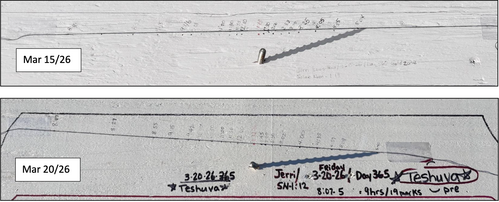
12. Sample Data examples for Northern Hemisphere: It’s good to record your data on the board, or place on a sticky note before taking a picture. Include: date; size of gnomon; place; name; location; solar noon time. Note how well the line is pulled from the first to the last mark and where solar noon is.
1. A marking board (about the size of a poster – see point #7 below)
2. A fine tip marking pen (the finer, the better) - at least 4 different colors will be helpful as you'll see in the power point files.
3. A gnomon that will cast a shadow (a nail, tall stick pin - anything that you can secure so it will not move). Experiment with different sizes on the same board while you are at it [eg: 3½” & 6”].
4. Sewing thread - to pull a line (do not use yarn/string, etc. - just use a single thread – see point 9).
5. A long measure - metre ruler/yardstick - metal is the best.
6. Find a location that will not have shadows from fences, trees, roofs, etc. (this is the most challenging part - this is the part you need to have some experimental time to find that "sweet spot" - even if you have to do something on top of the roof, or on top of a fence post - make arrangements for using a corner of a school grounds - maybe a corner of a church parking lot - use your imagination if your yard just will not work. But do try in your yard, as you may be surprised there is a spot between the trees somewhere that will work. The board should be as level as possible and you will want to position the length of your board in the "east/west" direction, as the sun moves across the sky. The board does NOT have to be exactly east/west. The board & gnomon must be secured so neither one moves, and if
you think there will be rain - you need some way to cover and protect it to prevent the board from warping. (Also, you will want to make sure outdoor animals [like cats] don't decide to use the gnomon for a scratching post.)
7. If you can get a few pieces of plastic corrugated signage material - that works really good (is not affected by moisture) - easy to nail to the ground, or even clamp to a table. In the files you will see where the gnomon is placed - that position is quite flexible. Finding the sweet spot without shadows from morning to evening is what will take the most time. The rest is easy - and fun! After the first day of tracking the shadow, you will easily see if you want to reposition the gnomon, or add another gnomon. Do 2 different sizes while you're at it. We suggest a gnomon of at least 3½”. For those that are close to the equator, it would be good to slant the gnomon at about a 45 degree angle. This is to keep the shadow marks away from the gnomon around the time of high noon.
8. Marking Points: The most important marking points are: 1st thing in the morning (as early as you can get); high noon [a must-see point 10]; and last possible shadow marking in the pm. Place stickpins, or push pins at the 3 marks and pull a thread from the first mark, to solar noon, to the last mark (and all pins in between if you have more). Do NOT wrap the thread around the pins - just follow one side. If you decide to mark about every hour even 10-12 days in advance (even every other day - just experiment), you will easily see a pretty curve. Every day the curve will begin to straighten a little more each time, until on the day of the equinox timing, the shadow line will be perfectly straight - until the next day when the curve will reappear - but it will be a flip to the other direction. The day of the straight-line shadow is the day of the equinox in your area – which determines the last day of the old
year, or the last day of the sun’s circuit through the constellations! The next day begins the next new year – at the first dawn light!
9. When pulling your line/thread, think about a bow and arrow (Robin Hood) ... you are pulling the "line" across your data set similar to how a string is pulled with a bow and arrow (the resulting patterns should appear the same ... people should see a slight "bow" on all days other than the equinox). You will quickly be able to look at the "midday marks" and see if they are away from the line or if they are ON the line. To pull the thread, only a single thread is necessary - of a good contrasting color – which is good for your close-up pictures.
10. To calculate solar noon just google: Solar noon in Salem Oregon (your city, state) including the date. For Feb 10 (date needed) it comes up as 12:26 pm as an example – but in areas that have day- light savings time, the solar noon will read as 1:26 pm. If possible, mark each hour according to the “solar noon minute” – eg: 826; 926; 1026; 1126, etc. [You’ll discover why this is so important if you have cloudy spots during the marking days.] Check your area for the solar noon time, as it will vary in patterns, either decreasing or increasing, depending on location.
11. Camera - you will need to take pictures - keep a file with dates and times - this needs to be well organized so you can compare what is going on from week to week, or day to day in the last 5-7 days of marking from about Mar 14 to 22. It is good to mark every hour on the last days of marking - and also mark/record [with a sticky note on the marking board] if something distorted the shadow (a wispy cloud; movement of the board). After marking for a few days, you'll figure out what has to be done as in this case, personal experience is the best teacher.
12. Sample Data examples for Northern Hemisphere: It’s good to record your data on the board, or place on a sticky note before taking a picture. Include: date; size of gnomon; place; name; location; solar noon time. Note how well the line is pulled from the first to the last mark and where solar noon is.
Recent
Archive
2026
No Comments